Opening
An age that can know. An age that must learn to do.
Never before have institutions had access to so much information. Governments can observe economies in near real time. Researchers can analyze datasets that would have been unimaginable a generation ago. Civil-society organizations can communicate across borders almost instantly. Artificial intelligence can search, classify, translate, summarize, model, and generate information at extraordinary speed.
And yet many of our hardest problems do not appear to be getting easier. Institutions can identify a threat and still fail to respond. They can possess excellent evidence and still make the wrong decision. They can agree on an objective and still fail to act together. They can launch ambitious programs and still fail to deliver. They can experience the same failure repeatedly and still fail to learn from it.
That contradiction is the starting point for The Capability Century.
For much of the information age, we operated under a powerful assumption: if we could produce more knowledge, connect more people, and make better evidence available, better decisions and better outcomes would follow. That assumption was not foolish. Better evidence can improve understanding, and better understanding can improve judgment. But none of those transitions is automatic.
Information must be noticed and interpreted. It must become a decision. The decision must become a commitment. Independent actors must coordinate around it. Resources must be mobilized. Implementation must survive contact with reality. Results must be measured honestly. Failure must generate adaptation rather than concealment.
Information does none of this by itself. People do these things through institutions.
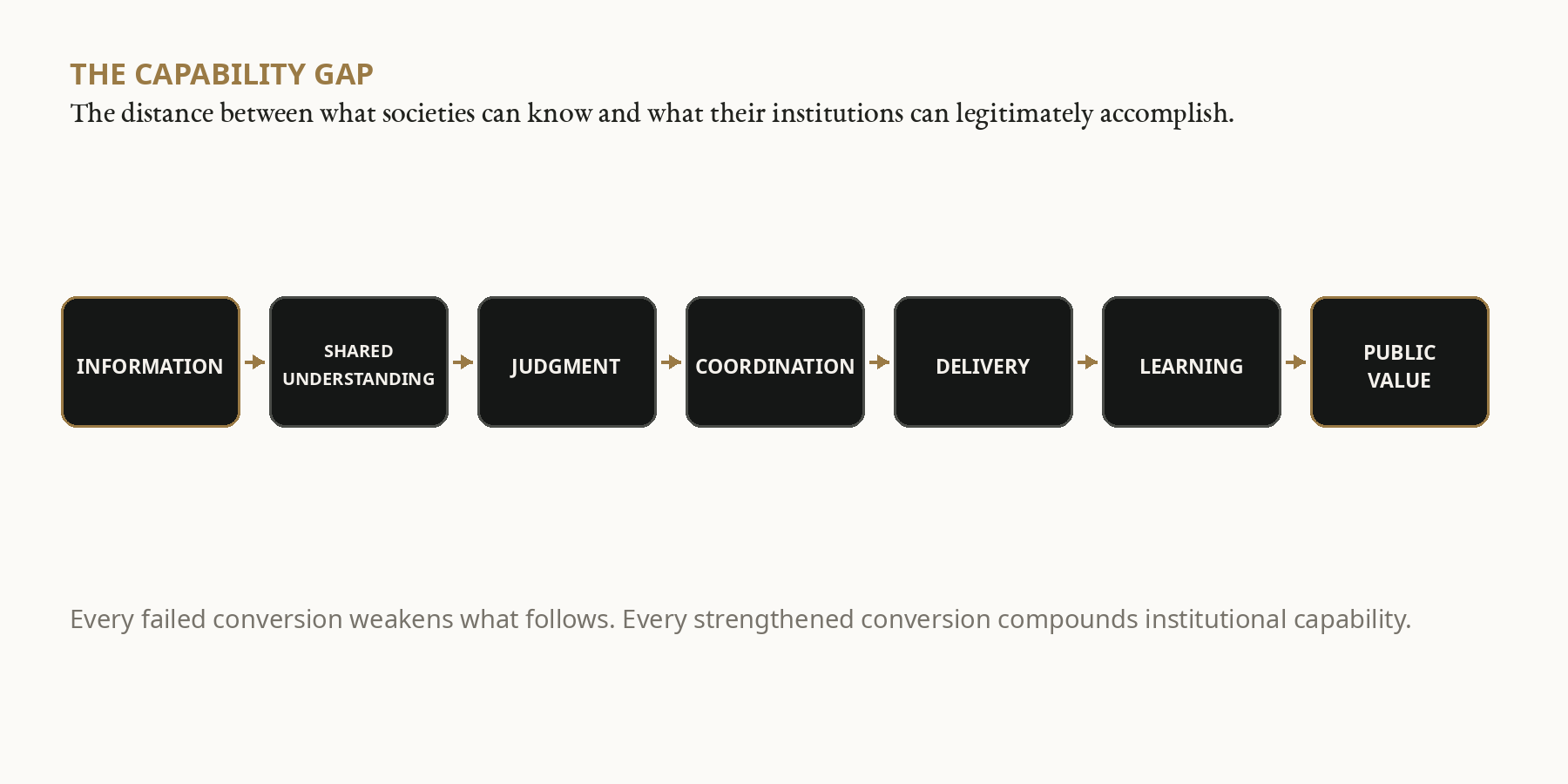
The defining infrastructure challenge of the twenty-first century is the widening distance between what societies can know and what their institutions can legitimately accomplish. I call that distance the capability gap.
Knowledge creates possibility. Capability creates outcomes.
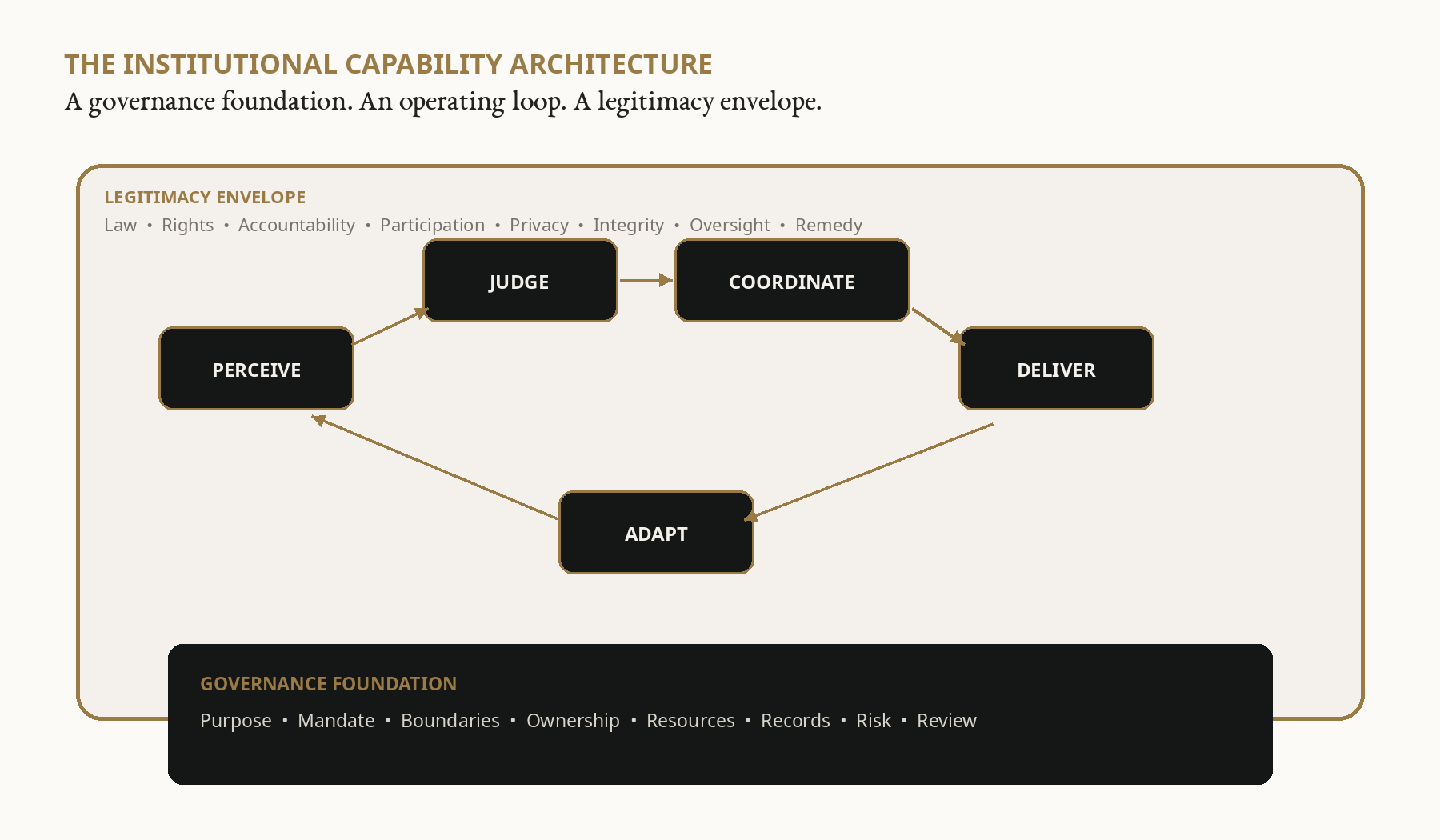
Institutional capability is the demonstrated ability of an institution—or an institutional ecosystem—to perceive relevant conditions, exercise sound judgment, coordinate actors, deliver intended outcomes, adapt through learning, and operate with legitimate authority and methods. Five capabilities form an operating loop: perceive, judge, coordinate, deliver, and adapt. Legitimacy surrounds the loop because capability is not inherently good. The goal is not maximum institutional power. It is legitimate capability.
01 / Chapter One
The Capability Gap
The capability gap begins with a simple observation: access to information is not the same as the ability to act on it. A modern institution can possess immense analytical resources and still remain institutionally weak. It may have data without perception, expertise without judgment, partners without coordination, money without delivery, experience without learning, or authority without legitimacy.
This explains why two institutions can possess comparable information and produce radically different outcomes. One may have clear authority, competent personnel, trusted leadership, effective routines, and the ability to mobilize partners. Another may be fragmented, politically constrained, internally distrustful, operationally weak, or unable to sustain action beyond one leadership cycle. The difference is not simply what they know. It is what they are capable of doing with what they know.
Many consequential failures persist after problems are well documented and plausible solutions are known. A policy can be technically correct and institutionally impossible. The sophisticated question is therefore not only, Is the idea right? It is, Is the system capable of acting on it?
The answer matters because weakness compounds. Poor perception produces flawed diagnosis. Flawed diagnosis weakens judgment. Weak judgment fragments coordination. Fragmented coordination produces inconsistent delivery. Weak delivery erodes trust. Reduced trust then weakens future cooperation and information flow. Leaders may respond with more research, reporting, meetings, dashboards, procedures, or technology—adding activity without increasing capability.
The relevant unit is often larger than one organization. Election integrity, public health, information integrity, climate resilience, and humanitarian response are produced by ecosystems of institutions. No single participant sees the whole environment, possesses complete authority, or can produce the desired outcome alone. The capability question becomes: can the ecosystem perceive, judge, coordinate, deliver, adapt, and remain legitimate across institutional boundaries?
The information age did not fail. It succeeded so extensively that it revealed the next constraint.
02 / Chapter Two
Why Knowledge Does Not Implement Itself
Every era develops a theory of progress. The agricultural age associated prosperity with land. The industrial age associated it with production. The information age increasingly associated progress with knowledge. If better information could be collected, if more people could be connected, and if expertise could become accessible, then better decisions would naturally emerge.
The information revolution transformed humanity’s ability to observe reality. It did not automatically transform humanity’s ability to act upon it. Knowledge has no agency. Data does not vote. Evidence does not allocate resources. Research does not build coalitions. Artificial intelligence does not possess democratic legitimacy.
Between knowledge and outcome sits a conversion chain: evidence must become understanding; understanding must become judgment; judgment must become coordination; coordination must become implementation; implementation must generate consequences; consequences must become learning; and learning must become durable institutional capability. Failure at any transition weakens everything downstream.
Implementation is often treated as the final administrative phase of a strategy. In reality, it is the moment at which an institution reveals what it is capable of doing. Many organizations can produce intelligent reports. Fewer can translate them into operating change. Many can develop sophisticated strategies. Fewer can sustain execution beyond leadership turnover. Many recognize emerging risks. Fewer build the coalitions required to respond.
Artificial intelligence makes this argument more important, not less. AI can accelerate forecasting, classification, translation, simulation, research, and decision support. It cannot determine legitimate public priorities, resolve constitutional trade-offs, create public trust, compel independent actors to coordinate, or make an organization capable merely because the organization adopts an advanced tool.
This is the information fallacy: assuming that because the bottleneck once involved access to knowledge, increasing knowledge must remain the highest-leverage intervention after information becomes abundant.
Knowledge reaches its limit. Institutions begin.
03 / Chapter Three
Institutions as the Operating Systems of Society
Societies do not act through information. They act through institutions. Between a scientific discovery and a vaccinated population, between visible financial risk and regulatory action, or between a constitutional threat and lawful resistance stands an institutional system.
That system determines who has authority, who receives information, whose judgment matters, which risks are recognized, what behavior is rewarded, how conflicts are resolved, whether decisions are implemented, whether errors can be admitted, and whether the exercise of power remains legitimate.
Most infrastructure is visible: roads, ports, electrical grids, digital networks. Institutional infrastructure is harder to see because it exists in rules, mandates, professional norms, routines, decision rights, expectations, relationships, and shared understandings. Yet it performs an equally fundamental function. It organizes behavior.
An organization and an institution are not the same thing. A ministry is an organization. The authority under which it operates, the budget rules constraining it, the norms guiding officials, and the informal practices determining what actually happens are institutions. This is why organizational reform so often disappoints. A new leader, office, strategy, or technology can change the appearance of the organization while its underlying incentives, power relationships, and constraints continue operating as before.
Capability becomes institutional when performance stops depending primarily on heroic individuals. A gifted founder, minister, organizer, civil servant, or executive may compensate for a weak system through personal energy, judgment, and relationships. For a time, the organization appears capable. But capability located mainly inside a person disappears when that person leaves, fails when scale increases, and can conceal the weakness it is compensating for.
The eradication of smallpox demonstrates the difference between scientific possibility and institutional capability. Vaccination had been understood for generations. Eradication required political commitment, production, local health workers, surveillance, reporting, logistics, containment, adaptation, and community cooperation. The vaccine created possibility. The institution created eradication.
Technology must be understood inside this operating system. Databases define what an institution can see. Algorithms determine which signals receive priority. Identity systems determine who can be recognized. A new technology inserted into an unchanged institution may simply digitize existing weakness. Technology becomes transformative when the institution changes with it.
The design question is not, What organization should we build? It is, What must the system become capable of doing reliably and legitimately? From that answer, authority, information, safeguards, resources, technology, and oversight can be designed backward.
04 / Chapter Four
The Complexity Mismatch
Institutions can employ intelligent people, follow established procedures, comply with governing rules, and execute their assigned responsibilities—and still fail because the problem has changed shape.
An institution built to govern a bounded domain encounters a problem crossing jurisdictions. A system organized around stable procedures faces conditions that change while decisions are being made. A hierarchy designed to concentrate authority confronts information distributed across communities, sectors, platforms, and countries. A planning process built on prediction faces actors who observe the plan and adapt in response.
This is the complexity mismatch: the gap between the variety, interdependence, speed, uncertainty, and contestation in an operating environment and the capabilities available to understand and govern it. The institution may not lack capability altogether. It may possess the wrong configuration of capability for the problem it faces.
Complexity is not the same as difficulty. Complicated systems can often be decomposed, tested, and modeled. Complex systems behave differently because components interact, those interactions alter the components themselves, effects can be delayed or distant, and actors learn, resist, imitate, anticipate, and adapt. Some problems are also politically and morally contested: how the problem is defined influences which solution appears reasonable.
The mismatch has several forms. Boundaries fail when problems cross organizational and jurisdictional seams. Time fails when annual budgets, slow procurement, and political cycles meet fast-moving threats or generational risks. Information fails when knowledge is distributed but decision-making is centralized. Incentives fail when each actor behaves rationally within its own mandate while the system produces an irrational result. Legitimacy fails when a technically optimized solution is unlawful, coercive, exclusionary, disproportionate, or publicly unacceptable.
The response is not maximum complexity. It is sufficient variety: distributed sensing, local discretion where appropriate, cross-sector partnerships, modular responses, delegated authority, escalation pathways, protected dissent, and continuous monitoring. Institutions need variable tempo—the ability to move quickly when delay is dangerous, slowly when legitimacy requires deliberation, and persistently when the problem outlasts current leadership.
The objective is complexity fitness: the ability of an institution or ecosystem to maintain legitimate performance as conditions, actors, information, and causal relationships change. The danger is not complexity itself. The danger is mismatch.
05 / Chapter Five
The Architecture of Institutional Capability
Institutions often respond to weakness by adding something: a team, a strategy, a committee, a dashboard, a technology platform, a new procedure, another layer of oversight. Each addition may be reasonable. None necessarily creates capability.
A warehouse contains components. An architecture arranges them so they can bear weight. Capability arises from how authority, information, people, resources, incentives, safeguards, and feedback are arranged—and whether those arrangements keep functioning under real conditions.
The architecture has three parts: a governance foundation, an operating loop, and a legitimacy envelope. The governance foundation defines why the institution exists, what it is authorized to do, where its boundaries lie, who is accountable, what resources it may use, which obligations constrain it, and how performance will be reviewed.
Above that foundation sits the operating loop:
- Perceive
- Turn relevant conditions into usable evidence while preserving context, provenance, uncertainty, and contrary signals.
- Judge
- Convert evidence into a defensible choice through explicit decision rights, trade-offs, challenge, and legal and ethical review.
- Coordinate
- Align interdependent actors’ authority, resources, information, risks, and commitments around a shared outcome.
- Deliver
- Translate commitments into verified outcomes through ownership, resources, sequencing, controls, risk management, and contingencies.
- Adapt
- Use evidence from consequences to change assumptions, systems, incentives, relationships, or safeguards, then verify improvement.
- Legitimate
- Ensure justified authority and defensible purpose through lawful, rights-respecting, proportionate methods, accountability, challenge, correction, and remedy.
The interfaces between these capabilities are where institutions often break. Reality must become evidence. Evidence must become decision. Decision must become commitment. Commitment must become outcome. Consequence must become learning. An institution can possess excellent functions and still fail because the handoffs do not carry the load.
This is why capability should be assessed as a profile, not a single score. Strong perception with weak judgment produces analysis without decision. Strong judgment with weak coordination produces strategies no one can mobilize. Strong coordination with weak delivery produces active coalitions without reliable implementation. Strong delivery with weak adaptation efficiently executes an increasingly obsolete model. Strong delivery without legitimacy can produce effective but unlawful or unsafe action.
Capability claims also require evidence discipline. A policy, assigned role, documented process, or risk register establishes design. It does not establish operation. Capability matures as practices move from designed, to implemented, to operating, to integrated, to adaptive.
And architecture must survive pressure. Can the decision process function when evidence is incomplete and leaders disagree? Can a partnership survive when money tightens? Can an ethics policy constrain action when leadership believes the mission is at risk? Can learning survive reputational pressure? Capability revealed only under favorable conditions is not durable capability.
The goal is architecture, not addition.
06 / Chapter Six
Coordination Without Command
No institution commands the system on which its success depends. A public-health agency cannot command hospitals, laboratories, employers, local governments, media, and communities to interpret risk identically. A foundation cannot command grantees, researchers, public institutions, and communities to sustain one theory of change. A government cannot command public trust. A coalition cannot command commitment.
This is the normal condition of complex public action. The challenge is to create coherent action among actors who cannot—or should not—be placed under one command.
Coordination is not communication. Communication transfers information. Cooperation provides support. Collaboration creates something jointly. Coordination aligns interdependent action. Integration combines structures or authority. A meeting, memorandum, shared dashboard, or joint report may help, but none proves that participating institutions can coordinate action.
Coordination exists when participants understand the shared outcome, know what they are responsible for, possess authority and resources to act, manage dependencies, exchange the information required for execution, resolve conflict, and remain accountable for commitments. It is also not consensus. Complex systems contain legitimate disagreement among actors with different purposes and obligations.
The goal is not to eliminate disagreement. It is to make disagreement governable.
A durable coordination architecture needs a specific shared outcome; the participants whose authority, knowledge, resources, consent, or restraint are actually necessary; bounded decision rights; interoperable information; reciprocal and resourced commitments; conflict, escalation, and exit processes; and accountability, learning, renewal, and sunset.
Trust reduces friction, but coordination should not depend on trust alone. Verification preserves trust through turnover, pressure, unequal power, and changing incentives. Networks also require power analysis. One actor controls money, another data, another legal authority, another community access. Removing formal hierarchy can make power harder to see, not less important.
Pluralism protects free societies by distributing power. But pluralism without coordination can become fragmentation. Well-designed pluralism becomes polycentric capability: multiple centers of decision-making retaining meaningful autonomy while connected through rules, information, monitoring, accountability, conflict mechanisms, and mutual adjustment.
Coordination without command is not a softer alternative to authority. It is one of the hardest institutional technologies of collective action.
07 / Chapter Seven
Institutions That Learn
Every institution has experience. Not every institution learns from it. A crisis occurs. A review is commissioned. Findings are written. Recommendations are approved. The document enters an archive. Leadership changes, attention moves, and the same incentives and information bottlenecks remain. Under pressure, the institution returns to familiar behavior.
The lesson was documented. It was not learned.
A lesson is learned only when the institution behaves differently because of it. Institutional learning is the demonstrated ability to use evidence from experience to change assumptions, decisions, routines, structures, resource allocations, relationships, or safeguards—and then determine whether those changes improved legitimate performance.
The learning loop has seven functions. Detect recognizes a failure, near miss, unexpected success, complaint, deviation, or ethical concern. Surface allows that signal to reach authority without making concealment more rational than reporting. Interpret distinguishes proximate cause from systemic cause and hindsight certainty from what could reasonably have been known. Challenge asks whether to improve the existing process or reconsider the model itself. Authorize gives someone ownership and power to change the system. Embed moves the lesson into budgets, roles, processes, incentives, contracts, technology, or safeguards. Verify tests whether behavior and outcomes actually improved.
Institutions can learn at different depths. Corrective learning fixes an error. Adaptive learning changes strategy as conditions change. Generative learning creates a new capability. Constitutional learning reconsiders mission, authority, rights, or legitimacy itself.
Memory is part of the architecture. An archive preserves information; it does not ensure retrieval. A checklist can preserve action while losing the reasoning that made exceptions important. Capable institutions govern what must be preserved, what must remain retrievable, what requires revalidation, and what should be retired.
Institutions also accumulate learning debt: recurring findings, extended action dates, recommendations without owners, closed actions without evidence of effectiveness, dependence on heroic individuals, and preventable recurrence. Learning debt differs from ignorance. The institution knows enough to recognize the problem but has not converted knowledge into durable change.
The defining advantage of a learning institution is not that it begins with the right answer. It is that error does not have to become destiny.
08 / Chapter Eight
Capability Without Legitimacy
A capable institution can still be dangerous. It can perceive accurately, judge strategically, coordinate complex networks, deliver reliably, and learn rapidly—and use every one of those capacities in service of repression, corruption, discrimination, deception, extraction, or concentrated power.
Capability describes what an institution can do. It does not determine whether the institution should do it. Operational effectiveness cannot establish institutional worth.
This is why legitimacy is not merely the sixth item in a list. It is a gate and an envelope around all the others. An institution should not compensate for unlawful surveillance by delivering a useful service, for discriminatory treatment through efficiency, or for deceptive political influence with measurable impact. Some failures are disqualifying.
Legitimacy requires justified authority and defensible purpose. It asks whether methods are lawful, necessary, proportionate, secure, and rights-respecting; whether affected people can participate or challenge decisions; whether powerful oversight can access evidence and alter conduct; whether harm can be recognized, corrected, and remedied; and whether capability remains worthy of trust under pressure.
As capability increases, the need for constraint increases with it. Artificial intelligence intensifies the problem because it expands perception, classification, prediction, automation, and scale while responsibility may be distributed across developers, vendors, deployers, data providers, models, and users.
This produces legitimacy lag: capability expands faster than authority, safeguards, oversight, participation, and remedy. It also creates legitimacy debt when temporary powers, data practices, automated decisions, confidential partnerships, or targeting systems continue operating without resolving the obligations created by their expansion.
Remedy is itself a capability. Can an institution reconstruct a decision, correct data, reverse an outcome, restore access, stop an intervention, compensate loss, change the system, and prevent retaliation? Oversight must possess real power. A body that receives reports but cannot access evidence or alter conduct is not meaningful oversight.
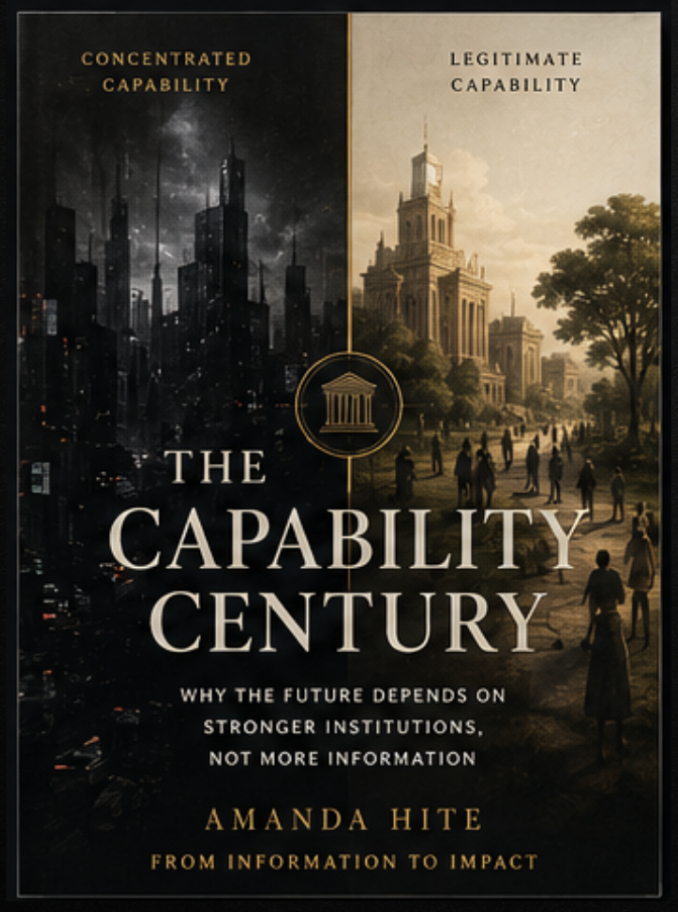
The choice is between concentrated capability—more prediction, targeting, automation, and control with less accountability—and legitimate capability: better information with privacy, distributed agency with traceable responsibility, technology with human accountability, coordination without erasing pluralism, and public value with challenge and remedy.
Technology will not choose between those futures. Institutions will.
09 / Chapter Nine
Building the Discipline
A discipline cannot be declared into existence. It cannot be created by naming a category, publishing a framework, announcing a standard, registering a trademark, or attaching certification to a consulting service. Those actions can create visibility. They cannot create knowledge.
A discipline becomes real when a community of inquiry and practice accumulates evidence that others can examine, challenge, reproduce, apply, revise, and teach. Institutional capability already draws on institutional economics, public administration, organizational theory, decision science, systems science, network governance, constitutional theory, human rights, implementation science, security practice, evaluation, and technology governance. The contribution is integration.
The field must remain contextual. Capability is always capability for something, under defined conditions, and within legitimate boundaries. It must ask which weakness becomes the binding constraint, how ecosystems should be assessed when authority is distributed, which interventions actually improve capability, how technology changes responsibility, and what evidence would require the framework itself to change.
A field that cannot specify how it might be wrong is not a discipline. It is a doctrine.
The discipline needs shared vocabulary and methodological clarity. Descriptive claims ask what exists. Explanatory claims ask why an institution behaves as it does. Evaluative claims ask how capable it is relative to defined requirements. Causal claims ask whether an intervention created change. Normative claims ask whether authority, methods, distribution, or impact are legitimate. Confusing them produces false certainty.
Measurement must come with an evidence ladder: assertion, documented design, corroborated operation, demonstrated outcome, and independent longitudinal evidence are not equivalent. Profiles are safer than league tables. Standards should be treated as hypotheses. Certification should come late, after validation, assessor competence, conflict rules, appeals, quality assurance, and independent governance exist.
The field must also confront dual use. Network analysis can protect vulnerable communities or identify them for targeting. Institutional assessment can improve public service or optimize coercive administration. Influence expertise can strengthen democratic participation or manipulate it. The discipline must be judged partly by the work it refuses.
Most importantly, the field must become capable of correcting its founder. The goal is not to protect a category. It is to build a discipline useful, open, and evidence-based enough that others can improve it without permission.
10 / Chapter Ten
The Capability Century
A century is not defined by its most powerful invention. It is defined by what institutions become capable of doing with it. Steam, electricity, telecommunications, computing, and the internet became historically consequential because institutions learned to finance, standardize, distribute, regulate, secure, maintain, and connect them to ordinary life.
Technology expands possibility. Institutions determine which possibilities become durable reality. Today, possibility is expanding faster than judgment. Interdependence is expanding faster than coordination. Technology is expanding faster than governance. Institutional power is expanding faster than legitimacy.
The central challenge of the coming decades is institutional conversion: information into understanding; understanding into judgment; judgment into commitment; commitment into delivery; delivery into learning; and power into legitimate public value.
As analytical tools and AI become widely available, advantage increasingly depends on what happens after access. Can an institution determine which information is reliable, preserve provenance and uncertainty, combine technical evidence with legal, historical, political, and community knowledge, decide before uncertainty disappears without pretending it has disappeared, mobilize necessary partners, detect harm, change course, and exercise power without violating rights or public trust?
This is a conversion advantage. The most capable institutions may not know the most in absolute terms. They will lose less value as information moves through the chain. They will preserve context as evidence travels, uncertainty as analysis becomes decision, accountability as decisions become distributed action, learning as personnel change, and legitimacy as capability expands.
Institutional capability is therefore a meta-capability. Capital without capability can be wasted. Technology without capability can be misapplied. Expertise can remain advisory. Authority can remain symbolic. Coordination can become performative. Power without legitimate capability can become dangerous.
This may create a new institutional divide. Some institutions will recognize new possibilities, integrate them, govern their risks, distribute their benefits, and improve them through use. Others will adopt the same technology or policy without the architecture required to govern it. The first group will compound capability. The second may compound dependency, exposure, and institutional debt.
AI accelerates this divide. It can strengthen perception, judgment support, coordination, delivery, and learning. It can also scale error, intensify surveillance, centralize hidden power, and allow institutions to act faster than they can observe consequences. A capable model inside an incapable institution can increase the scale of institutional failure.
Capability should be funded as infrastructure, not treated as overhead left after the “real” work is paid for. Governments must ask not only which policy to pass, but which authority, workforce, information pathways, delivery systems, safeguards, coordination mechanisms, and maintenance will make it real. Philanthropy must ask what durable capacity remains after a grant ends. Civil society must strengthen local trust, contextual judgment, relational memory, and adaptive practice without becoming a bureaucratic imitation of larger institutions. Technology companies must recognize that products increasingly perform institutional functions.
For free societies, the task is especially important. Free societies deliberately distribute power. Courts remain independent. Media can challenge government. Civil society organizes outside the state. Political parties compete. Individuals possess rights the state may not override for convenience. This friction is part of freedom.
The answer is not to imitate unaccountable centralization. It is to make pluralism operational: to create the capacity to perceive, decide, coordinate, deliver, and adapt through institutions that remain pluralistic, rights-respecting, accountable, and open to correction.
Conclusion
The next infrastructure
The information age built an extraordinary apparatus for collecting, transmitting, and measuring knowledge. That apparatus did not become obsolete. It revealed the next constraint. Measurement can show that a goal is off track. It cannot assign legitimate authority, mobilize financing, resolve competing interests, coordinate autonomous actors, create public consent, build delivery systems, or ensure that failure changes future behavior.
The Capability Century is not an argument for larger institutions, more bureaucracy, or concentrated control. Nor is it an argument that capability can be reduced to efficiency. The institutions we need must be able to act and remain lawful; to move with urgency and preserve deliberation; to coordinate without erasing autonomy; to learn without evading accountability; and to use powerful technologies without surrendering human judgment, rights, or remedy.
The work begins by treating capability as infrastructure. Start with the legitimate outcome and work backward. Assess capability profiles rather than reputations. Find the binding constraints and the interfaces where value disappears. Design authority to fit the problem. Fund coordination explicitly. Build learning into delivery. Make legitimacy part of the architecture, not an afterthought. Test the system under pressure. Preserve the ability to correct it.
We have built an age that can know. Whether this becomes an age that can do—legitimately, adaptively, and together—will be an institutional choice.
The century ahead will be shaped by whether our institutions can turn what they know into legitimate, coordinated, adaptive action.